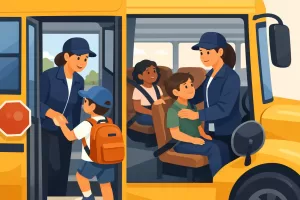
At 6:25 a.m., a school transport route can look fine on paper and still fail in real life. One late pickup leads to a rushed arrival, one poorly placed stop creates avoidable road risk, and one missing parent update turns a small delay into a morning problem for several families. That is why a school route optimization case study matters. It shows how route planning works when the priority is not just efficiency, but safe, dependable daily transport for children.
For schools and parents, route optimization is often misunderstood as a cost-cutting exercise. In practice, the better use of route planning is service control. A strong route should reduce unnecessary travel time, keep pickup windows realistic, improve stop safety, and make communication easier when traffic conditions change. Those outcomes matter more than shaving a few minutes off a map.
What this school route optimization case study looks at
Consider a mid-sized school transport operation serving students across several residential clusters with 13- to 23-seat buses. The original setup had grown over time rather than being designed from the start. New students were added where space was available, some pickup points were chosen for convenience rather than traffic safety, and departure timing was based on habit instead of current road conditions.
The result was familiar. Some routes ran smoothly, but others had too many turns into narrow streets, inconsistent pickup windows, and longer ride times for the first students onboard. Parents were receiving updates, but often only after delays had already become noticeable. Drivers were managing well, yet the routing itself was doing them no favors.
The goal of this case study was straightforward: improve punctuality and safety without making the service feel rigid or difficult for families. That balance matters. A route that is technically efficient but unrealistic for households or unsafe at pickup points is not a good route.
The starting issues behind the route problems
The first issue was stop placement. Several stops had been selected because they were close to individual homes, but they increased turning movements, roadside waiting risk, or congestion during peak school traffic. In student transport, the nearest stop is not always the best stop.
The second issue was route layering. A few buses were covering mixed demand zones that looked manageable by distance, but not by morning conditions. A short route on a map can become unreliable if it crosses school zones, signal-heavy intersections, and apartment pickup clusters at the wrong time.
The third issue was timing assumptions. Historical pickup times had been kept in place even after enrollment patterns changed. As more students were added, dwell time at each stop increased. A route that once had enough buffer became a route that was late three times a week.
There was also a communication issue. Parents generally want the same thing from a school bus provider – certainty. If the bus is on time, that is good. If the bus is delayed, timely updates matter almost as much. Without route consistency, communication becomes reactive instead of planned.
How the optimization process was handled
This school route optimization case study used a practical review process rather than a purely software-led one. Routing tools can help, but school transport needs local judgment. A route for children has to be checked against traffic behavior, roadside conditions, age group needs, and driver experience.
First, the operator reviewed student addresses by cluster instead of treating every pickup as a separate point. That made it easier to see where stops could be consolidated without creating unreasonable walking distances. In dense areas, one well-chosen stop can be safer and more reliable than three door-to-door variations.
Next, each route was examined for actual morning flow. That included recurring congestion points, school zone queues, turning restrictions, and loading conditions. Travel time was measured against realistic weekday conditions, not ideal road speed.
Then stop safety was reviewed. This part is easy to underestimate. A stop may appear convenient, but if the bus has to double-park briefly, reverse awkwardly, or load students near heavy traffic, it should be reconsidered. In some cases, moving a stop by a short distance improved visibility and reduced roadside conflict significantly.
Finally, pickup windows were reset with more discipline. Instead of promising narrow windows that could not be sustained, the revised routes used timing that drivers could realistically maintain. That gave parents a more dependable routine and reduced the pressure on both transport coordinators and drivers.
Changes made in the revised route plan
The revised plan did not rely on one dramatic fix. It improved the operation through several smaller corrections working together.
Some low-efficiency stops were combined into common collection points where road conditions were safer. A few students had slightly longer walks with guardians, but overall loading became faster and more orderly. For younger children, stop changes were kept conservative. For older students, there was more flexibility.
A number of routes were shortened geographically but made more consistent in sequence. Instead of zig-zagging between nearby zones to satisfy old habits, buses moved through cleaner pickup patterns. That reduced backtracking and made estimated arrival times more predictable.
Bus assignment also changed. Not every route should use the same vehicle size. Matching student count, road conditions, and stop layout to the right bus improves service quality. On tighter roads or lower-load routes, smaller buses often perform better because they handle neighborhood access more efficiently and spend less time maneuvering.
Communication procedures were tightened as well. Once timing became more predictable, parent updates became more useful. If a route started later because of heavy rain or a traffic incident, notifications could be sent early enough to help families adjust rather than simply explain what had already happened.
Results from the school route optimization case study
The most visible improvement was punctuality. Arrival variance dropped because routes were no longer built around outdated assumptions. Buses still encountered normal traffic fluctuations, but fewer routes were structurally late.
Ride time fairness improved too. In many school routes, the earliest pickup students bear the longest travel burden. That is sometimes unavoidable, especially with spread-out demand, but it can often be reduced. In this case, cleaner clustering and better sequencing shortened average onboard time for the earliest pickups while keeping overall route efficiency stable.
Safety improved in a quieter but more meaningful way. Better stop placement reduced rushed boarding, unnecessary crossing exposure, and difficult curbside loading. These changes do not always show up in headline numbers, yet they matter most to parents and schools.
Operationally, drivers benefited from the revised plan. Clearer routes lower cognitive strain during peak hours. That helps drivers focus on road conditions and passenger care instead of compensating for a route that never worked properly. For school transport providers, this is an important point. A route should support safe driving behavior, not test it every morning.
What schools and parents should take from it
The lesson from this school route optimization case study is not that every route should be as short as possible. The better lesson is that school transport should be reviewed as a live operation. Student rosters change, traffic patterns shift, and what worked last year may not be the best setup now.
For schools, that means asking better questions than just whether the bus arrives. Are stops safe for loading? Are ride times reasonable for the youngest passengers? Are route windows realistic enough to support consistent communication with families?
For parents, it helps to understand that route improvements sometimes involve trade-offs. A slightly longer walk to a common pickup point may support a safer stop. A bus arriving within a dependable window is often better than one promised at an exact minute but regularly late. Reliability comes from route discipline, not optimistic scheduling.
This is also where an experienced operator makes a difference. School transport is not the same as general charter movement. It requires planned routing, licensed personnel, ongoing oversight, and clear communication habits. Providers that handle recurring student transport well tend to look beyond map distance and focus on daily service conditions. That is the standard companies such as Shanz Transportation & Services aim to maintain in school bus operations.
A good route is rarely the one with the fewest kilometers. It is the one families can trust on Monday morning, in heavy traffic, under real conditions, week after week. If a school transport route feels fragile, it usually is. Reviewing it early is far easier than managing the same preventable delays all semester long.